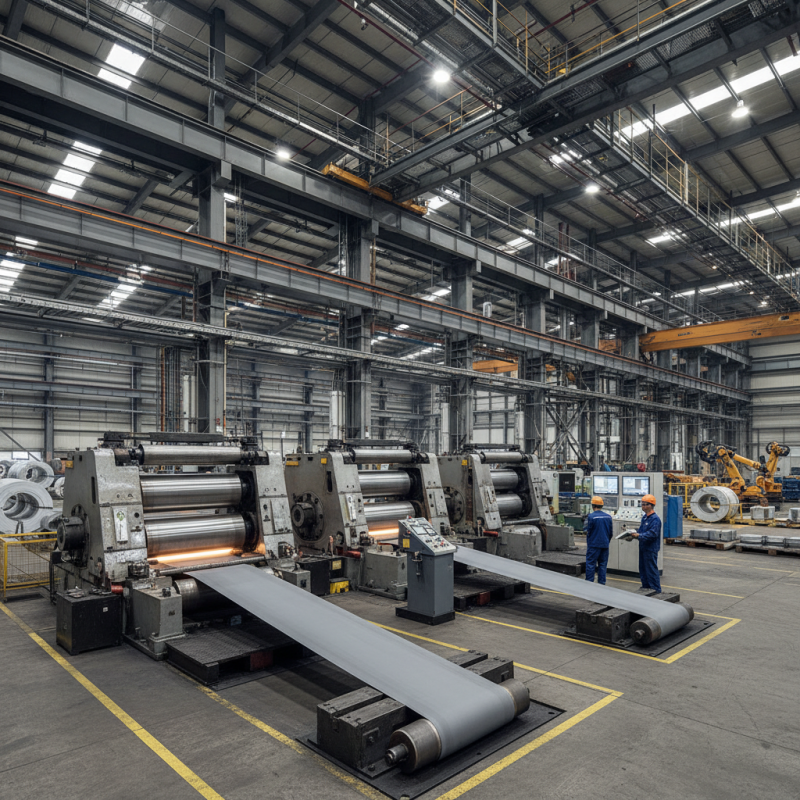
What is a Tandem Cold Rolling Mill and How Does It Work?
A tandem cold rolling mill is a crucial piece of equipment in the metalworking industry. It processes metal strips through multiple rolling stands, each reducing the thickness of the metal further. This method enhances the strength and surface finish of the material.
As the metal passes through each stand, the tandem cold rolling mill efficiently shapes it. The process is continuous, allowing for high production rates. Operators must monitor the system closely to maintain quality. Any small error can lead to defects in the final product.
The design of a tandem cold rolling mill can vary, reflecting different production needs. It can be complex and often requires expert knowledge. Understanding how it works involves both technical insights and practical experience. Analyzing its operational challenges can lead to improvements.
What is a Tandem Cold Rolling Mill?
A tandem cold rolling mill is a specialized industrial setup for processing metal strips, primarily steel or aluminum. In this process, multiple rolling stands are arranged in sequence. The metal strip passes through each stand, reducing its thickness and enhancing surface quality. According to industry reports, tandem mills can achieve thickness reductions of up to 90% with each pass.
These mills operate at high speeds and can produce a wide range of thicknesses. For instance, thicknesses as thin as 0.2 mm are achievable with precision. The technology allows for efficient mass production while maintaining dimensional accuracy. However, challenges exist. The metal strip can suffer from defects like edge wave or internal stresses if not properly managed. This requires careful monitoring throughout the rolling process.
Operational efficiency often hinges on equipment design and maintenance. Aging machinery may lead to inconsistencies in product quality. Additionally, process parameters must be fine-tuned to avoid problems like excessive wear on rollers. Reflections on these aspects reveal that while tandem cold rolling mills significantly improve productivity, they also necessitate ongoing investment in technology and workforce training to mitigate potential issues.
Key Components and Functionality of Tandem Cold Rolling Mills
Tandem cold rolling mills are integral to metal processing. They consist of multiple rolling stands arranged in series. This design allows for efficient thickness reduction in metals. Each stand reduces the material's thickness further, leading to a smooth finish.
Key components of a tandem cold rolling mill include the rolling stands, hydraulic systems, and automation controls. Rolling stands are where the metal passes through rollers, creating the desired thickness. Hydraulic systems apply the necessary force on the rollers. Automation controls enhance precision. The process typically achieves a thickness reduction of up to 90 percent. According to the International Journal of Advanced Manufacturing Technology, tandem mills can enhance production efficiency by over 50%.
However, operations are not without challenges. Consistent quality is a key concern. Variations in temperature or materials can lead to defects. Moreover, maintenance of complex components can be daunting. Many plants report downtime due to unexpected failures. A balance between efficient production and quality control remains imperative. Despite advancements, these pitfalls persist in many facilities.
What is a Tandem Cold Rolling Mill and How Does It Work?
| Component | Description | Functionality |
| Rolls | Heavy cylindrical tools that reduce thickness of metal sheets. | Apply pressure to materials, achieving the desired thickness and surface quality. |
| Driving System | System that powers the rolls, usually consisting of motors and gearboxes. | Enables the rotation of rolls, controlling speed and torque. |
| Hydraulic System | System that controls the gap between rolls and applies force. | Maintains the desired parameters during the rolling process, ensuring optimal performance. |
| Cooling System | System to control the temperature of the rolls and material. | Prevents overheating, protecting equipment and preserving material properties. |
| Automation System | Control system that manages the operation of the mill. | Optimizes production, enhances efficiency and increases safety through real-time monitoring. |
Operational Processes in Tandem Cold Rolling: A Step-by-Step Breakdown
Tandem cold rolling mills are vital in metal processing. They create thin strips of metal by passing through multiple rollers. The operational process is intricate and involves several stages.
In the first stage, sheets of metal are fed into the mill. The rollers apply high pressure to these sheets, reducing their thickness. It's crucial to maintain consistent speed and temperature. A slight error can lead to defects in the metal's surface.
Next, the metal advances to the next set of rollers. Each pass reduces thickness further, refining the material. The tension between rollers is also vital. Too much tension can cause stretching, while too little leads to irregularities. Operators must constantly monitor these parameters. The process ends with the metal being coiled up, ready for use. While efficient, this method requires skill and precision. It's a balancing act that can always improve.
Market Applications and Benefits of Tandem Cold Rolling Technology
Tandem cold rolling mills play a crucial role in the metal processing industry. Their efficiency allows for the production of thin metal sheets with consistent quality. This technology is widely used in automotive, aerospace, and construction sectors. Reports indicate that the global cold rolling market is projected to grow at a CAGR of 5.8% from 2021 to 2028. This growth exemplifies the increasing demand for lightweight materials in various applications.
The benefits of tandem cold rolling technology are significant. It reduces the number of passes required to achieve desired thickness, enhancing productivity. For instance, tandem mills can perform multiple reductions in a single pass, minimizing energy consumption. A recent study highlighted that energy savings can reach up to 30% compared to conventional methods. Furthermore, the end products exhibit improved mechanical properties, which are vital for durability.
However, there are challenges to consider. The initial setup cost can be high, which may deter smaller manufacturers. Also, without proper maintenance, operational issues can arise, affecting output quality. Balancing these factors is essential for companies aiming to leverage this technology effectively. While tandem cold rolling mills offer compelling advantages, careful planning and investment are necessary for optimal results.
Recent Innovations and Efficiency Metrics in Tandem Cold Rolling Mills
Tandem cold rolling mills have seen significant advancements lately. These innovations focus on increasing efficiency and reducing waste. For instance, improved roll cooling systems help maintain optimal temperatures. This leads to better material properties and less energy consumption.
Another key development is automation integration. Automated control systems enhance precision in thickness and surface quality. It allows for real-time adjustments as the metal passes through the mill. However, the learning curve for operators can be steep. Training is essential to fully utilize these advanced systems.
Tip: Regularly update your maintenance schedules. This prevents unexpected breakdowns. Calibration of equipment is also crucial. It ensures that the quality remains consistent. Keep an eye on the overall production flow. Identifying bottlenecks early can save time and resources.